


Short Description

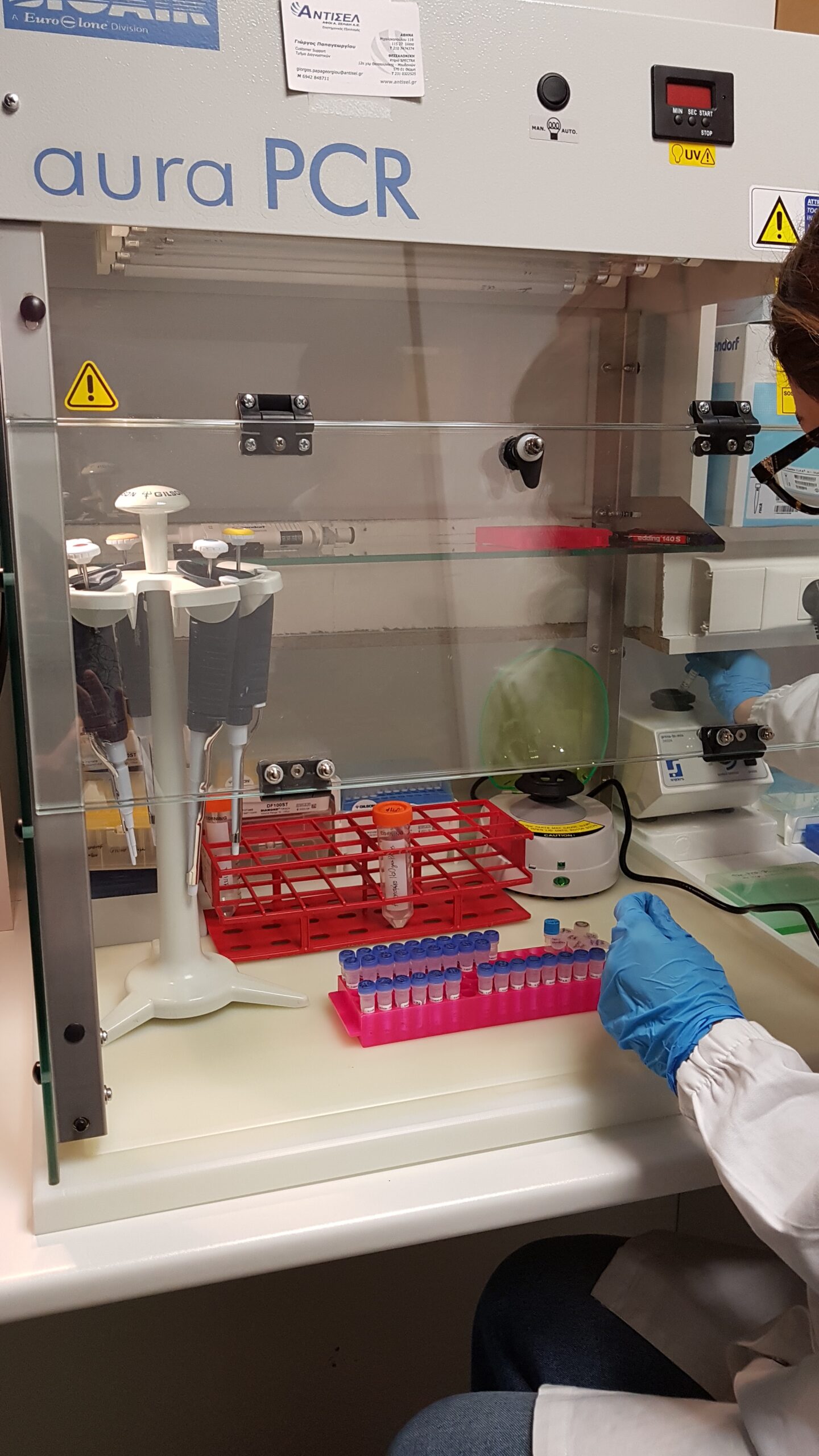
The Laboratory of Genomic Variation and Genetic Epidemiology was founded in 2015 (ΦΕΚ 1532 τ. Β’/21-07-2015). The Laboratory is co-housed and its members closely collaborate with the Laboratory of Population Genetics and Evolution (founded in 2002). The Laboratory’s focus is on the study of biological mechanisms at the genetic and molecular level on two main axes: biomedical research, with an emphasis on rare and common human diseases, and the study of biodiversity, through the use of bioinformatics tools for the analysis of genetic diversity data at the organismal and population level (population genetics). In the field of biomedical research, the members of the Laboratory are engaged in the study and understanding at the genetic and molecular level of mechanisms that lead to the occurrence of pathological conditions in humans (identification and investigation of genetic variants, study of variants of unknown/uncertain clinical significance, transcriptomic analysis of genes carrying pathogenic/potentially pathogenic variants), either in rare hereditary disorders or in multifactorial diseases with a genetic basis, using both classical and advanced analysis technologies for the detection of genetic and molecular markers. As a result of long-term international collaborations and funding by its past and present members, the Laboratory maintains a biobank of biological and genetic material samples from pediatric patients with a rare neurodevelopmental phenotype, as well as patients with rare and common multifactorial diseases. A key element of the progress of the work carried out in the Laboratory is the collaboration with clinical scientists. In the field of biodiversity, the members of the Laboratory work on population and evolutionary genetics, the development of molecular, statistical and bioinformatic tools for the research of genetic diversity and the mechanisms of adaptation of plant species at the genome level. In addition, through collaborations and funding, the Laboratory maintains a biobank of biological and genetic material of endemic plant species of Northern Greece. The Laboratory supports the educational needs of a significant number of related undergraduate courses, such as "Evolutionary Biology", "Population and Evolutionary Genetics", "Genetics I", "Laboratory Course VII: Application of Genetics", "Biostatistics", "Molecular Biology and Genetics of Plants", and others, while it actively participates in research programs in the field of Population and Evolutionary Genetics. Faculty members of the Laboratory coordinate the Department’s Master’s Program on “Applied Bioinformatics –Biological Data Analysis” and teach in a significant number of postgraduate courses.

  • Study of genetic diversity of organisms and populations, e.g. genome-wide association studies (GWAS), evolutionary genetics
  • Study of the genetic and molecular basis of human diseases (rare inherited diseases and multifactorial diseases)
  • Bioinformatics processing and data analysis at genome and transcriptome levels
  • Genomics of biodiversity (tools for research on genetic diversity)
  • Population and evolutionary genetics of plant species (spatial and temporal patterns of genetic diversity of wild plant populations)

2025 – : Odyssey: Connecting molecular and geographical biodiversity data: ELIXIR Commissioned Services Project: 2024-SCIENCE-BFSP
2023 – 2025: “Improving the conservation status of Pinus heldreichii at national level through traditional and innovative methods”, Ministry of Environment & Energy – Green Fund
2023 – 2025: “ECOeDNA”, Ministry of Environment & Energy – Green Fund
2017 – : ELIXIR-GR: The Greek Research Infrastructure for Data Management and Analysis in Life Sciences (ESFRI European Research Infrastructures, HORIZON 2020)

  1. Biodiversity – Population Genetics – Forest Genetics
    Konstantinidou G.P., Giannakopoulos N.E., Pariotis I., ……, Tsifintaris M., Georgitsi M., Galatsidas S., & Papageorgiou A.C. (2025) Genetic diversity and population structure of black pine (Pinus nigra Arn.) in Mt. Athos, northern Greece, Forests 16(9), 1399.
    Tsiripidis, I., Stamellou, S., Papageorgiou, A. C., & Drouzas, A. D. (2024). Ecological and Biogeographical Imprints in a Beech Glacial Refugium. Diversity, 16(3), 152.
    Budde, K. B., Hötzel, S., Müller, M., Samsonidze, N., Papageorgiou, A. C., & Gailing, O. (2023). Bidirectional gene flow between Fagus sylvatica L. and F. orientalis Lipsky despite strong genetic divergence. Forest Ecology and Management, 537, 120947.
    Waterhouse, R. M., Adam-Blondon, A. F., Balech, B., Barta, E., Chua, P. Y. S., Di Cola, V., … & Gabaldón, T. (2023). The ELIXIR Biodiversity Community: Understanding short-and long-term changes in biodiversity. F1000Research, 12.
    Siskas, E., Bella, E., Papageorgiou, A. C., Kappas, I., Tsiripidis, I., & Drouzas, A. D. (2023). DNA-based identification of Abies cephalonica, A. alba and their hybrid (A.× borisii-regis) at the individual-level. Plant Biosystems-An International Journal Dealing with all Aspects of Plant Biology, 157(1), 24-37.
    Tegopoulos, K., Fountas, D. V., Andronidou, E. M., Bagos, P. G., Kolovos, P., Skavdis, G., … & Grigoriou, M. E. (2023). Assessing Genetic Diversity and Population Differentiation in Wild Hop (Humulus lupulus) from the Region of Central Greece via SNP-NGS Genotyping. Diversity, 15(12), 1171.
    Cardoni, S., Piredda, R., Denk, T., Grimm, G. W., Papageorgiou, A. C., Schulze, E. D., … & Cosimo Simeone, M. (2022). 5S‐IGS rDNA in wind‐pollinated trees (Fagus L.) encapsulates 55 million years of reticulate evolution and hybrid origins of modern species. The Plant Journal, 109(4), 909-926.
    Varsamis, G., Adamidis, G. C., Merou, T., Takos, I., Tseniklidou, K., Dimitrakopoulos, P. G., & Papageorgiou, A. C. (2022). Changes in Watering Frequency Stimulate Differentiated Adaptive Responses among Seedlings of Different Beech Populations. Biology, 11(2), 306.
    Tsipidou, O., Leinemann, L., Korakis, G., Finkeldey, R., Gailing, O., & Papageorgiou, A. C. (2021). Fine-Scale Spatial Patterns of the Genetic Diversity of European Beech (Fagus sylvatica L.) around a Mountainous Glacial Refugium in the SW Balkans. Forests, 12(6), 725.

    Genetic epidemiology – Population genetics – Biomedical research
    Alexander J*, Potamianou H*, ……, Georgitsi M (2016). Targeted Re‐ Sequencing Approach of Candidate Genes Implicates Rare Potentially Functional Variants in Tourette Syndrome Etiology. Front Neurosci 10:428, eCollection 2016.
    Schrag A, Martino D, ……., Georgitsi M, et al. (2019). European Multicentre Tics in Children Studies (EMTICS): protocol for two cohort studies to assess risk factors for tic onset and exacerbation in children and adolescents. Eur Child Adolesc Psychiatry 28(1):91-109.
    Alexander J, Strobel T, Georgitsi M, et al. (2019). Neuropathology-driven whole-genome sequencing study points to novel candidate genes for healthy brain aging. Alzheimer Dis Assoc Disord 33(1):7-14.
    Tsetsos F, Roumeliotis A, ……, Georgitsi M (2020). Genetic variation in CARD8, a gene coding for an NLRP3 inflammasome-associated protein, alters the genetic risk for diabetic nephropathy in the context of type 2 diabetes mellitus. Diab Vasc Dis Res 17(6):1479164120970892.
    Topaloudi A, ….., Georgitsi M*, Paschou P* (2022). A Myasthenia Gravis genome-wide association study implicates AGRN as a risk locus. J Med Genet 59(8):801-809.
    Topaloudi A, ….., Georgitsi M, Drineas P, Paschou P (2023). PheWAS and cross-disorder analysis reveal genetic architecture, pleiotropic loci and phenotypic correlations across 11 autoimmune disorders. Front Immunol 14: 1147573.
    Tsetsos F, …..; PGC TS Working Group; TSAICG; TSGeneSEE Initiative; EMTICS Collaborative Group; TS-EUROTRAIN Network; TIC Genetics Collaborative Group; ….., Georgitsi M, Hoekstra PJ, Paschou P. (2024). Genome-wide Association Study points to novel locus for Gilles de la Tourette Syndrome. Biol Psychiatry 96(2):114-124.

No data found.

Name Capacity
Μαργαρίτης Τσιφιντάρης Μεταδιδακτορικός Ερευνητής

No data found.

Photo Gallery

Information

Director

Τμήμα Μοριακής Βιολογίας & Γενετικής, Δημοκρίτειο Πανεπιστήμιο Θράκης, Δραγάνα, Αλεξανδρούπολη